Animals Are The Most Inefficient Way Of Making Protein
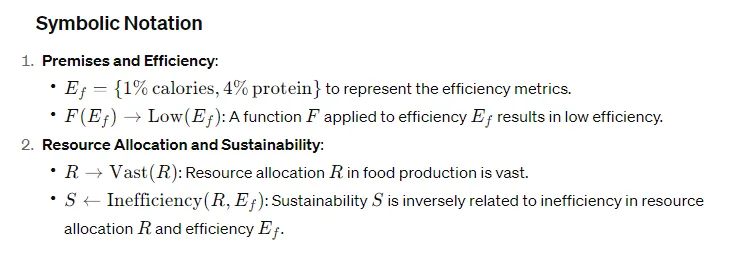
In order to aptly disassemble the nuances of the current agricultural practices, particularly focusing on livestock farming within the framework of factory farms, or more technically referred to as Concentrated Animal Feeding Operations (CAFOs), I structured the following argument formally. In the context of the United States, based on 2017 data from the USDA, the Sentience Institute estimated in 2019 that 70.4 percent of cows are housed in these CAFOs. By definition, a CAFO is characterised as a farm operation with more than 700 dairy cows or 1,000 beef cattle in confinement, creating a system for maximising production efficiency but, as we will explore, possibly at significant environmental and ethical costs.
Source: Factory Farming Cows
Premise 1: Livestock, specifically cattle, consume significant amounts of plant-based feed throughout their lifespans. On average, a cow on a factory farm consumes approximately 4,500 kg of plant-based feed over an 18-month period until it is slaughtered.
Premise 2: The World Health Organization recommends that humans consume at least 400 grams of fruits and vegetables per day for optimal health. Comparatively, it would take approximately 21 humans to consume the same amount of plant-based food as one cow does over its 18-month lifespan.
Source: WHO: Healthy Diet
Premise 3: Globally, around 900,000 cows are slaughtered daily. Over an 18-month period, this equates to 486,000,000 cows. If each cow consumes around 4,500 kg of feed in its lifetime, the total feed consumed by all these cows amounts to approximately 2.187 billion metric tonnes.
Source: Our world in Data: How Many Animals get Slaughtered Every Day?
Premise 4: Cows convert roughly 95% of their caloric intake into thermal energy and other metabolic functions. Only 1% of the calories and 4% of the protein from feed are converted into edible output for human consumption. This conversion rate implies that a substantial portion of the feed is essentially lost to human food production.
Source: World Resources Institute (w/UN & WB): Creating a Sustainable Food Future, p.37
Conclusion: Our global food production system, especially in livestock farming, is devastatingly inefficient. To produce a relatively small quantity of animal protein, a huge amount of plant-based feed is required. For example, only about 1% of the calories from feed are converted into edible beef calories. This process diverts food with the potential to feed humans into producing much less food. Given the scale of the cattle’s feed consumption and its minimal conversion rate into edible beef, the inefficiency becomes even more glaring when considering the loss of potential human nutritional benefits in this process.
With billions of kilograms of plant-based feed essentially wasted, the opportunity to directly nourish a significant portion of the global population is squandered. The total caloric content of the cows’ lifetime feed amounts to approximately 7.65 trillion kcal. This translates to enough calories to theoretically feed about 3.83 trillion human-days worth of food. When distributed over a year, this would be sufficient to feed approximately 10.49 billion humans for a year, based on an average daily caloric need of 2000 kcal.